
Sheriff Active Warrants
The official Union County Sheriff's Office site publishes an Active Warrants page for local warrant information. The page is maintained on the sheriff's official Google-hosted site under unionco.org and is list based, not a searchable database with filters. Research found a warrant division page with local names, short offense labels, photographs or image slots, an embedded active-warrants image, and a confidential tip form.
Visible entries at research time included offense labels such as forgery, theft, burglary, and DUI. Those examples should be treated as a snapshot of the public page, not a complete warrant database. The public list may not show every active warrant, recently served warrant, sealed warrant, juvenile matter, or court-issued bench warrant. For any safety-critical question, call the sheriff or the issuing court instead of relying only on a web list.
The Union County Sheriff's Office homepage identifies Sheriff Scott W. Hahn and lists the office at 103 South Second Street, Lewisburg, PA 17837, with office hours of 8:00 AM to 4:00 PM, phone (570) 524-8716, and fax (570) 524-8731.
The official sheriff homepage is shown in the image captured from the Union County Sheriff's Office site.
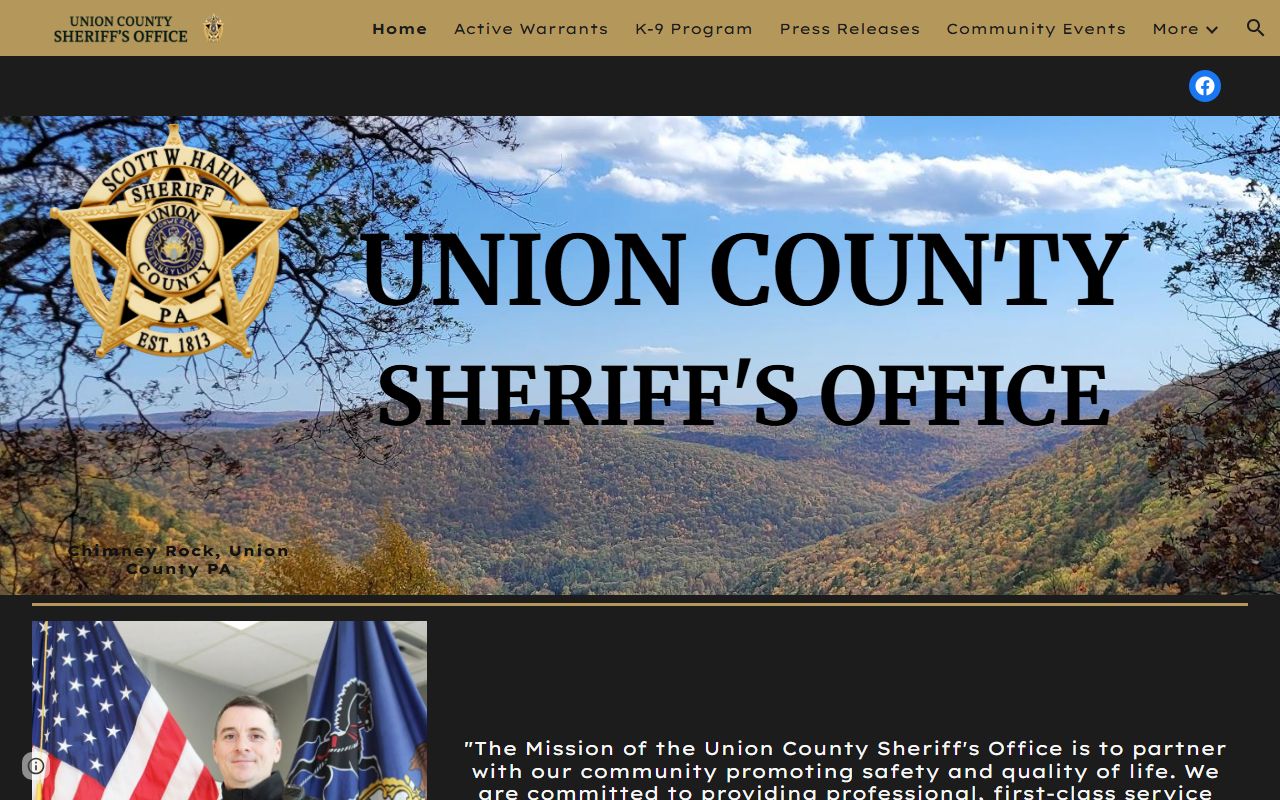
This office contact is the practical starting point when the online warrant list does not answer whether a warrant is still active or what court procedure applies.
What the Warrant List Shows
The Union County sheriff warrant page does not publish a full case-management record for each person. It shows enough information to identify a listed person and invite tips, while other details may require a direct sheriff call, a court docket search, or contact with the issuing court. Do not assume the absence of a bond amount, docket number, or issuing judge means the warrant does not exist. Those fields simply were not visible in the captured public text.
| Field | Visible on the Official Page? | Use |
|---|---|---|
| Name | Yes | Identifies the listed person on the local active-warrant page. |
| Charge or offense label | Yes | Gives a short reason label such as theft, forgery, burglary, or DUI. |
| Photo or image slot | Yes | Helps distinguish listed people when the sheriff publishes an image. |
| Tip channel | Yes | Links users with information to the sheriff's confidential tip form. |
| Docket or warrant number | Not visible in captured text | Use UJS Case Search, the sheriff, or the issuing court for record-specific detail. |
| Bond amount or surrender terms | Not visible | Confirm directly before taking action. |
The public warrant page itself is shown in the image captured from the sheriff's Active Warrants page.
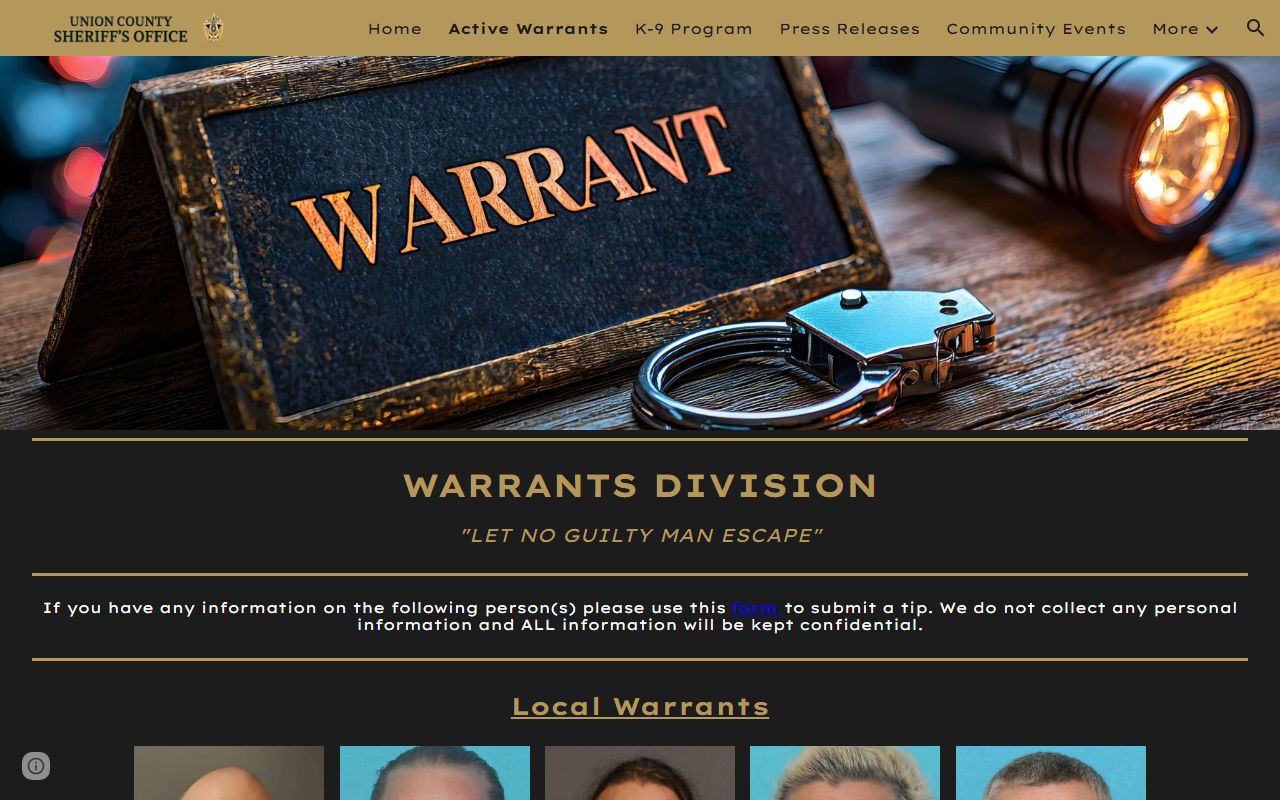
The image reinforces that the official source is a list and tip page, so it should be paired with phone and docket checks for current status.
How to Check a Union County Warrant
A complete Union County warrant lookup uses several channels because different warrant types may live in different systems. The sheriff's active list is the local public-facing channel for listed sheriff warrants. Pennsylvania UJS Case Search can show public docket events, including warrant-related entries, bail activity, hearings, and failures to appear when those events are available on a public docket. Magisterial District Courts can be important when the matter began as a traffic citation, summary offense, preliminary criminal case, landlord-tenant case, or small civil proceeding.
- Check the sheriff's official active-warrant page for a listed name and charge label.
- Call the Union County Sheriff's Office at (570) 524-8716 when the web list is unclear, outdated, or safety-critical.
- Search Pennsylvania UJS Case Search by participant name, docket number, OTN, complaint number, or citation number if the warrant may be tied to a court case.
- Contact MDJ 17-03-01 in Lewisburg or MDJ 17-03-02 in Mifflinburg if the case began in Magisterial District Court.
- For a known Common Pleas criminal matter, contact the Clerk of Courts or the court handling the docket before assuming payment or appearance will resolve the warrant.
| Lookup Channel | Search Field or Input | Required? | Notes |
|---|---|---|---|
| Sheriff active-warrant page | No searchable field located | No | Review the public list by visible name and charge label. |
| Sheriff phone confirmation | Name or identifying case detail | Practical requirement | Use for current status, service questions, and web-list limits. |
| UJS Case Search | Participant name, docket number, OTN, complaint number, or citation number | Depends on search mode | Use for public docket events tied to warrants, hearings, bail, or failure to appear. |
| Magisterial District Court | Citation, docket, name, or issuing office | Depends on case | Use when the warrant comes from traffic, summary, preliminary criminal, or lower-court proceedings. |
This sequence matters because a sheriff list may show only selected active local warrants, while court dockets may reveal bench warrants issued after missed hearings, unpaid financial obligations, probation events, or contempt proceedings. The sheriff, court, and docket sheet each answer a different question.
Bench Warrants and MDJ Cases
Bench warrants are court orders, often issued after a person misses a hearing, fails to comply with a court direction, misses payment obligations, or does not appear in a traffic or criminal matter. In Union County, many traffic and summary matters begin in Magisterial District Court. The two Union County MDJ offices are 17-03-01 at 103 S Second Street in Lewisburg and 17-03-02 at 343 Chestnut Street, Suite #2, in Mifflinburg. A warrant connected to a citation or preliminary criminal matter may need attention at that lower-court office before the Common Pleas record tells the whole story.
For Common Pleas criminal dockets, search UJS for the docket sheet and look for entries that mention failure to appear, bench warrant, bail, hearing notices, sentencing, or probation. For a traffic or summary case, search by citation number first, then by participant name if the citation number is unavailable. Docket entries can lag behind clerk-office activity, so direct court confirmation remains important when timing matters.
Tips, Records Requests, and Sheriff Limits
The sheriff's active-warrant page asks people with information on listed persons to use a linked Google form. The page states that the sheriff does not collect personal information through that tip route and that information will be kept confidential. A tip form is not a warrant search tool for the person named in a warrant; it is a way to provide information to law enforcement.
Public-records requests can be useful for sheriff administrative records, but active investigations, sealed warrants, juvenile warrants, security-sensitive information, and criminal-history information may be withheld or routed under different rules. Pennsylvania court case records are governed by UJS public access policy, while county agency records can use Union County's Right-to-Know process when the record is not a court case file. The safer request path is to identify whether the record is a sheriff administrative record, a court docket, a criminal-history record, or an active law-enforcement matter before submitting a request.
The sheriff civil service source captured for the manifest is available from the Sheriff's Office civil service page.
Civil service is separate from criminal warrants, but it shows how the same sheriff office also handles court process and why the correct division or record type matters.
Resolving an Outstanding Warrant
A person who believes a Union County warrant exists should confirm the warrant with the sheriff or issuing court before going to a courthouse counter, making a payment, or assuming a web docket is complete. The next step may be a court appearance, bond issue, payment plan, surrender instruction, attorney filing, or contact with probation. The correct route depends on whether the warrant came from a criminal case, traffic case, payment issue, probation matter, contempt matter, or another court order.
Important: Ask an attorney or the issuing court about procedure before surrendering or appearing, especially when custody, bail, or probation may be involved.
Restricted Warrant Records
Not every warrant is meant for broad public display. Sealed search warrants, juvenile-related warrants, sensitive law-enforcement matters, and records tied to restricted court files may be unavailable online. UJS docket sheets also are not Pennsylvania State Police criminal history background checks. A public docket can show events in a case, but CHRIA rules govern criminal-history dissemination, and expunged or limited-access cases may not appear in ordinary public searches. If a warrant question involves a juvenile, sealed case, or restricted docket, expect the public answer to be limited.